Operations
The run, the rider and the cash — one board.
A delivery order becomes a run: assigned to a rider, watched by the dispatcher, tracked by the customer and settled the second it is handed over. The back office sees a board; the rider sees their own phone. Both are looking at the same order.
Dispatch board·rider app·COD and prepaid·tips go to the rider
Every run out of the door, on one board.
Who has it, how far it is going, how long it has been out, and how much money is coming back.
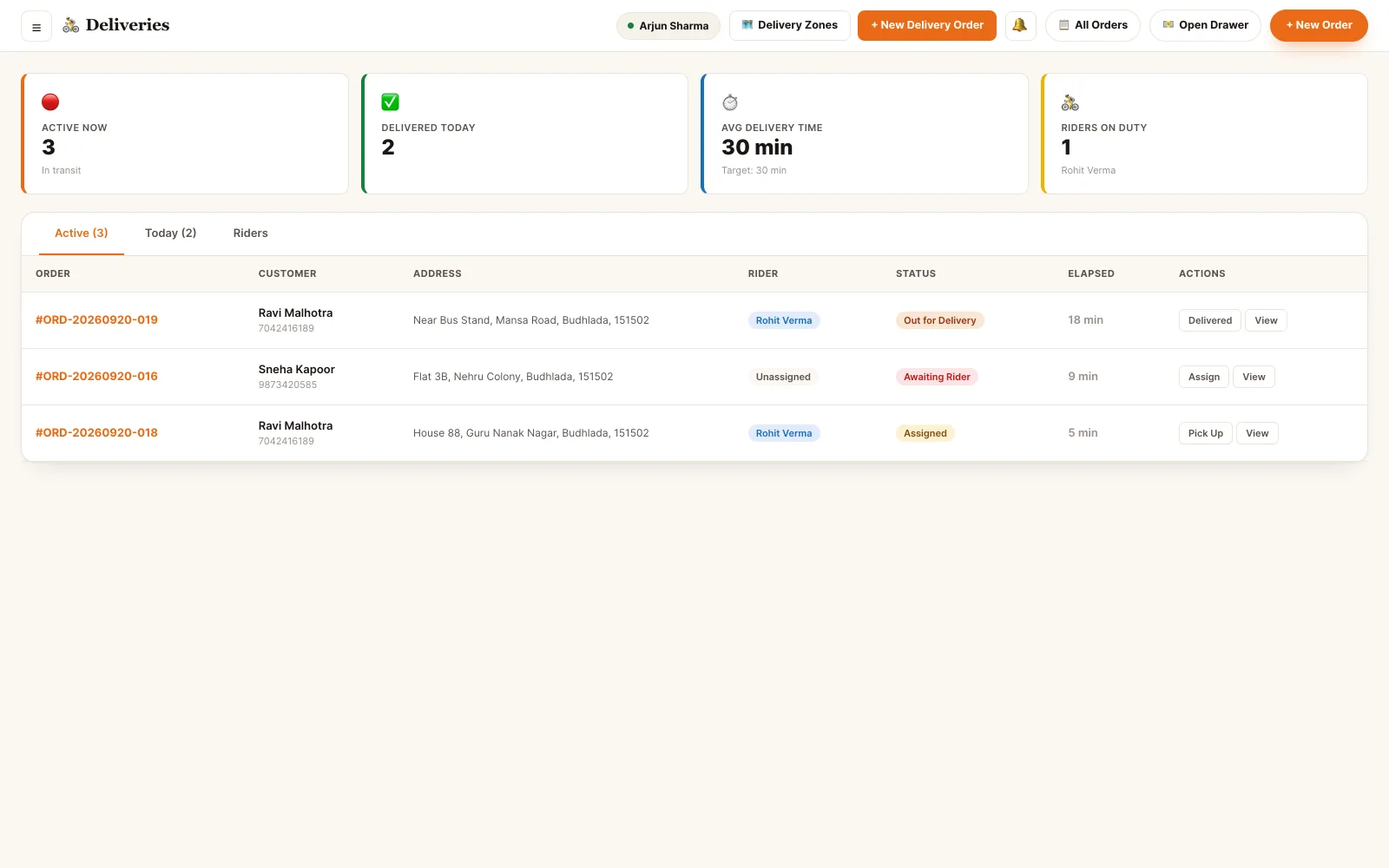
Back office · delivery dispatch
From assignment to the cash coming back.
Assign a run
Pick a rider from the ones on duty — the board shows who is already out and who is at the restaurant.
Watch it live
Assigned, picked up, out for delivery, delivered — pushed to the board and to the diner's tracking page.
Handle the address properly
Autocomplete biased to your neighbourhood, saved area tiles, a landmark line, and a map pin.
Collect on delivery
The rider sees the exact amount to collect; the settlement lands on the same bill the restaurant raised.
Pass on the tip
A tip added by the customer is attributed to the rider who delivered the order, prepaid or at the door.
Set how far you go
A maximum delivery distance and a delivery fee — flat, free above a minimum, or by distance zone.
The rider's phone is the same system.
Not an export, not a WhatsApp message with an address in it. The rider logs in and sees only their own runs, with the one number that matters on every card.
- My runs, grouped by state: to pick up, on the way, delivered
- An item checklist at pickup, so nothing leaves the counter uncounted
- Address with the landmark, one tap to call the customer, one tap to open maps
- The exact amount to collect, with the delivery fee and any tip already in it
- Mark delivered, or record a failed delivery with a reason
- Earnings for the week: deliveries, distance and the tips received on them
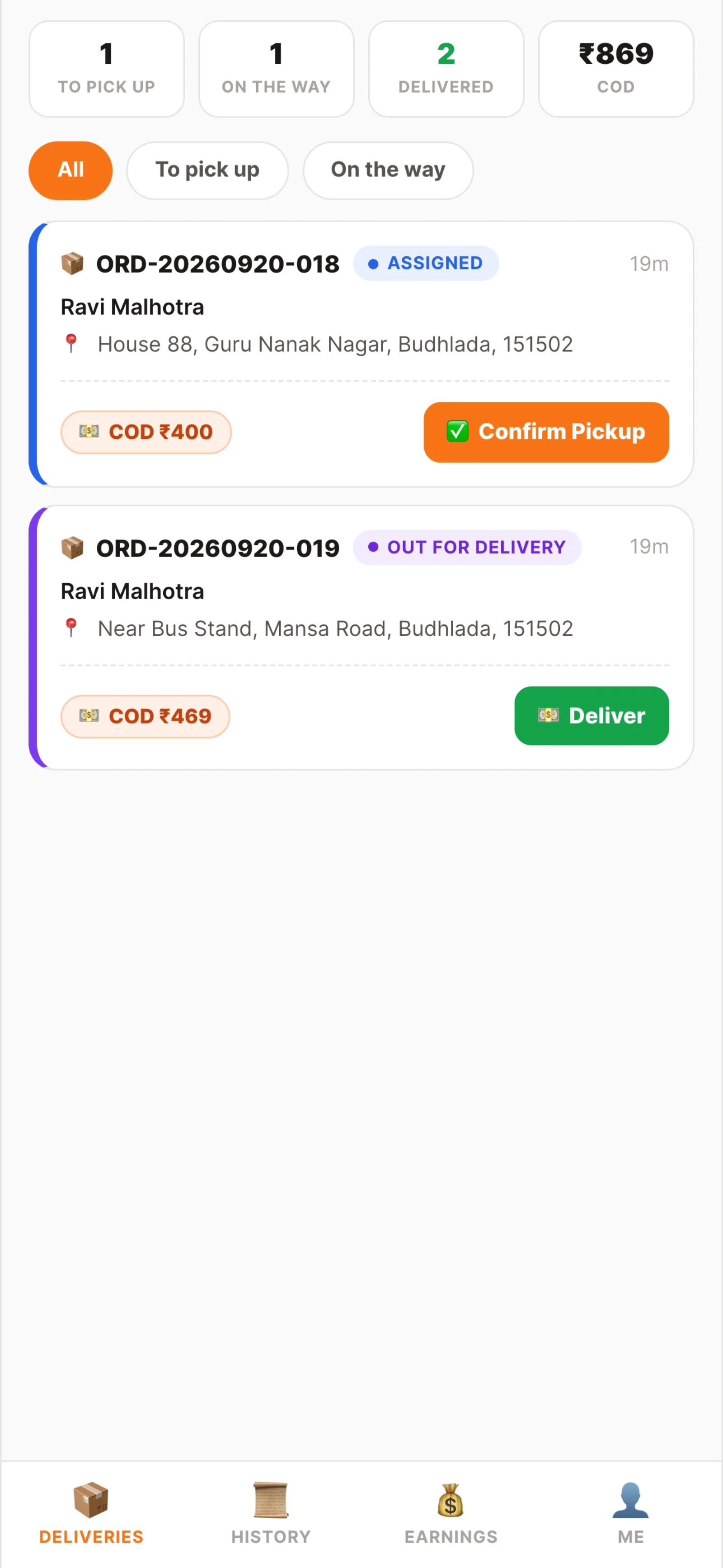
Rider app · my runs
One amount, computed once.
The figure the rider collects is the bill the restaurant raised — same subtotal, same GST, same delivery fee, same rounding. Nobody re-adds it on a notepad, so there is nothing to reconcile at the end of the night.
- Cash on delivery settles the real bill; the payment is recorded against the order
- Prepaid runs are labelled prepaid, so no one asks for money twice at the door
- The delivery fee is itemised on the bill, not folded quietly into the food total
- Tips are held against the rider who delivered, whether prepaid or handed over
- A delivery beyond the restaurant's maximum distance is refused at checkout
One run, four stages
A run is an order with an address.
Delivery does not hold its own order, its own bill or its own customer — it adds the rider, the distance and the doorstep to the ones that already exist.
Who sees which runs.
- Owner The whole module and its settings. Delivery areas, the fee model, the maximum distance, and who is allowed to dispatch.
- Manager Runs dispatch. Assign and reassign riders, mark delivered, record a failed delivery, and read the delivery numbers in analytics.
- Supervisor Dispatch on shift. The same board and the same actions during service, without the settings behind it.
- Cashier Assign and track, nothing more. The counter can hand a waiting order to a rider and then follow that run — a deliberately lighter permission than managing the module.
- Delivery agent Only their own runs. A rider sees the runs assigned to them and can move those through pickup, on-the-way and delivered. No board, no other rider's work, no back office.
Permissions are atomic and checked on every endpoint. A role is a named bundle of them, not a rank — a staff member can hold several bundles at once and their access is the union.
See it running on your menu.
We set the restaurant up with you — menu, tables, staff and printers — rather than handing over a login and wishing you luck.